

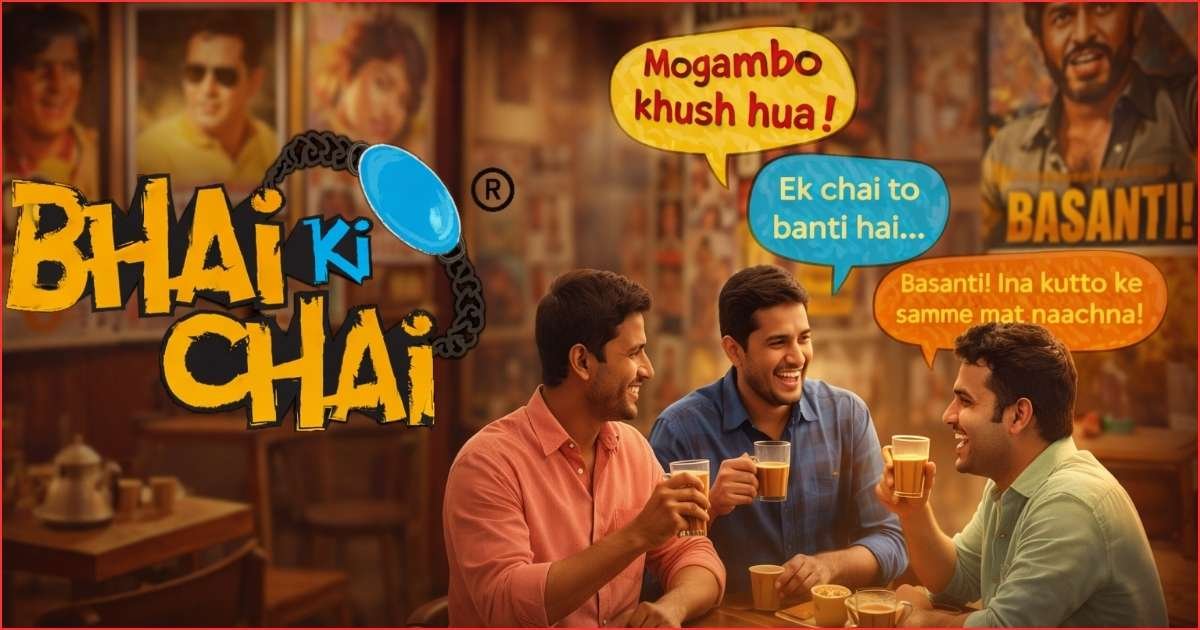
Hyderabad: Bollywood chai branding drove the identity of BHAI ki CHAI by turning Hindi cinema into a familiar social language inside the café, where film references, dialogues and visual cues supported conversation rather than dominating the space.
The brand did not treat Bollywood as a decorative theme. Instead, it used cinema as a cultural shorthand that customers already knew. That choice mirrored the role chai had long played in India’s daily life. By combining the two, the café built an atmosphere that felt instantly recognisable.
Bollywood had occupied a distinct place in Indian society. Its dialogues had entered daily speech and were quoted in offices, homes and public spaces. BHAI ki CHAI used that shared habit in its branding. As a result, customers encountered cinema-inspired elements that felt familiar from the first glance.
The brand did not rely on nostalgia alone. It used familiarity as the main device, much like the comfort associated with a regular cup of tea. Therefore, the café experience stayed grounded in routine social behaviour rather than in spectacle.
Its interiors and visual identity drew subtly from popular cinema. Film posters, lines and expressions appeared across the space, but they did not overwhelm the experience. Instead, those references worked as conversation starters. Customers often responded to them instinctively, either to break the ice or to extend discussions already under way.
That restraint shaped the space in a precise way. Bollywood did not become the main attraction. It functioned as a background language that supported tea and conversation. As a result, the brand avoided turning cinema into a loud visual gimmick.
Bollywood chai branding linked tea and shared conversation
This Bollywood chai branding worked because chai and cinema served a similar social purpose. Both had been experienced collectively and were usually followed by discussion, recall and opinion. Watching a film, or repeating a famous dialogue, was rarely a solitary act. In the same way, drinking chai had remained a shared ritual across settings.
BHAI ki CHAI placed itself at that intersection. It used cinema not as a separate attraction, but as a familiar layer within an already social activity. Consequently, conversations moved naturally inside the café, supported by cues that people already understood.
The brand also avoided restricting itself to one film era or one genre. That decision kept the references broad and inclusive. Older customers recognised expressions associated with classic cinema. Younger visitors, meanwhile, connected with more contemporary cultural cues. Because of that balance, the brand did not appear dated. It also avoided looking driven only by short-term trends.
Bollywood offered another advantage. Its language had remained informal, expressive and widely understood. That tone closely matched the character of chai stalls and neighbourhood cafés. So, by adopting that language, BHAI ki CHAI reinforced a position that felt approachable rather than aspirational.
The result was significant for the customer experience. The café did not feel like a carefully staged concept built for display. Instead, it felt closer to an extension of everyday social life. That emotional accessibility helped the brand remain easy to enter, easy to read and easy to remember.
Bollywood chai branding stayed flexible without changing the brand core
The branding choice also gave the café room to adapt. Cinema kept evolving, and the references inside the brand could evolve with it. Yet the core identity did not need to change. The language could refresh itself over time while the foundation stayed familiar. That made the approach culturally flexible without making it unstable.
Customers often reacted to this environment at a subconscious level. They did not always stop to analyse the branding in explicit terms. However, they recognised the comfort built into it. The setting felt lived-in rather than staged. Therefore, the brand complemented the main experience instead of competing with it.
That subtlety set BHAI ki CHAI apart in a crowded café market. Many themed spaces had used concepts for novelty. Here, however, cinema worked as a shared point of reference, not as a spectacle. The restraint matched the brand’s wider emphasis on simplicity and repetition.
In effect, Bollywood chai branding succeeded because it reflected how people had already communicated in everyday life. It did not ask customers to learn a new code. It used one they already spoke. Much like chai itself, Bollywood remained familiar, widely understood and woven into routine interaction.
That combination helped BHAI ki CHAI create a setting where people felt comfortable staying longer. The brand language supported the experience without distracting from it. Tea remained central. Conversation remained natural. Cinema, meanwhile, stayed in the background as an accessible and shared cultural vocabulary.
