

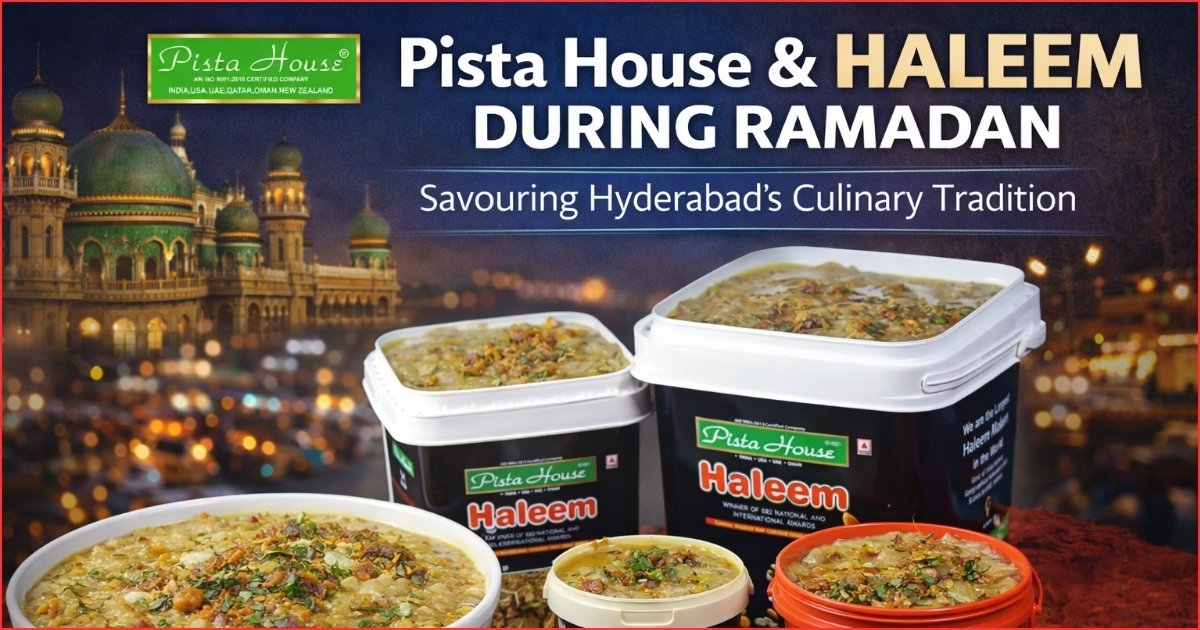
Hyderabad: Pista House Haleem became a visible marker of Ramadan across the city. It signalled the start of a season defined by evening gatherings and shared meals. More than convenience, it represented consistency and timing. Over the years, the brand shifted Haleem from a largely home-bound preparation to a widely anticipated public ritual. Yet the dish remained firmly seasonal. As a result, it stayed anchored in tradition rather than trend.
Haleem in Hyderabad reflected culinary influences shaped by Arab, Persian and Deccan kitchens. The method remained demanding. It required long hours over controlled heat. It also required constant stirring to achieve uniform texture. Wheat, lentils and meat had to blend completely. Meanwhile, spices had to remain balanced without dominating the base. Because of this process, Haleem rewarded patience over speed.
For many households, Haleem belonged specifically to Ramadan evenings. It followed the day’s fast. At the same time, it brought families to the same table. Families ate it at home, while friends shared it outdoors. Neighbours exchanged portions across streets and apartment blocks. Consequently, the dish carried social meaning alongside flavour. It became food tied to a calendar rather than daily consumption.
How Pista House Haleem became a citywide marker
Pista House entered a setting where Haleem was limited to homes and a few traditional outlets. Its impact came through standardisation. The brand retained the familiar character of the dish. However, it introduced predictable output across batches. It prepared Haleem in large deghs and repeated the method with close supervision. Therefore, customers encountered similar texture and flavour each evening. Over time, that reliability built routine.
As Ramadan nights grew busier, demand increased sharply. Traffic intensified near markets and mosques. In addition, shopping hours extended late into the night. Meanwhile, many families had less time for slow cooking. Ready-made Haleem therefore became more sought after. Pista House scaled up production during the season. Even so, it prioritised uniform taste at higher volumes. This balance strengthened public confidence in Pista House Haleem.
Soon, Haleem became part of public conversation. People compared thickness and spice levels. They also debated preferred garnishes. Moreover, they timed visits to avoid peak crowds. Queues outside outlets turned into a familiar Ramadan sight. In many circles, recommending Pista House Haleem became routine. As a result, the brand’s name aligned closely with the start of the season.

Seasonal identity and diaspora connection
The dish also travelled with Hyderabad’s diaspora. Families who moved abroad carried memories of Ramadan evenings. They missed the routine, the aroma and the shared serving style. When Haleem appeared in international outlets, it recreated a familiar setting. In addition, younger generations experienced a flavour often described in family stories. Thus, Pista House Haleem functioned as a bridge between geographies.
Despite its popularity, Haleem largely resisted year-round expansion. Many seasonal foods lose that boundary over time. However, Haleem maintained its association with Ramadan. This continuity preserved its cultural weight. It also prevented the dish from becoming an ordinary menu item. Pista House Haleem benefited from that restraint, as the anticipation remained intact each year.
Today, Haleem forms part of Hyderabad’s broader identity. It appears in travel writing and cultural commentary. It also surfaces in family recollections passed across generations. Although kitchen methods have modernised, the expectation has not shifted. People continue to seek the same flavour each Ramadan night. When the season ends, production pauses. That pause sustains the tradition for the following year.
