

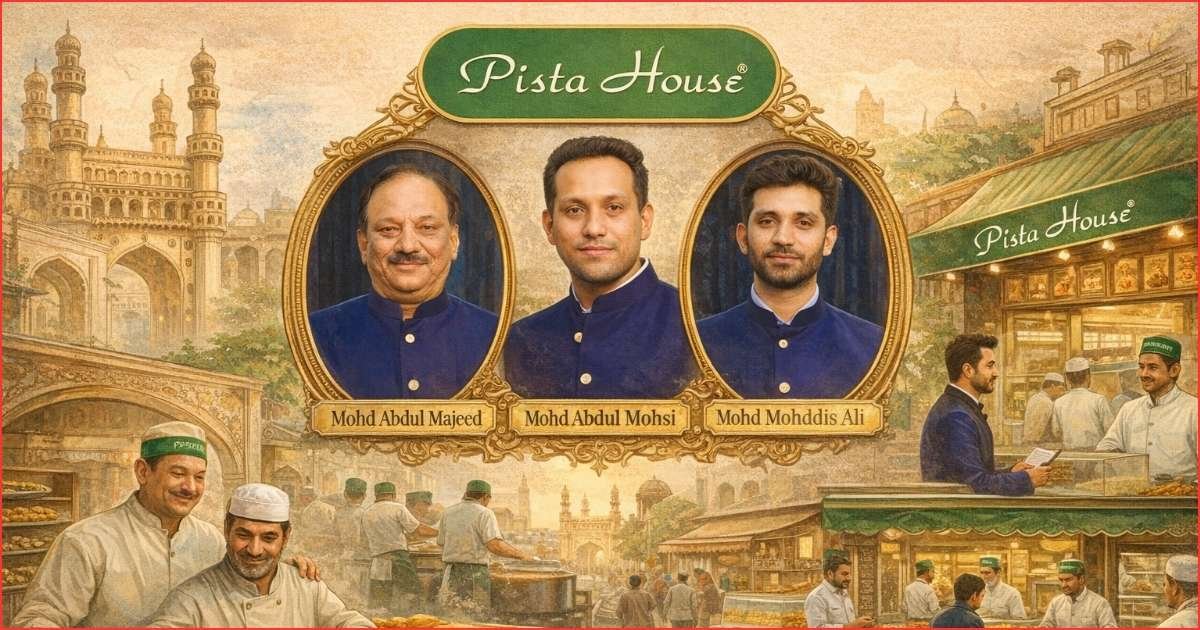
Hyderabad: Pista House sustained its growth and brand identity through a family-led structure that prioritised continuity, hands-on involvement and the transmission of culinary values across generations in Hyderabad’s evolving food landscape.
The brand began as a bakery near Charminar, where family members were directly involved in daily operations. They supervised preparation, engaged with customers and monitored quality at close range. This proximity created a working understanding of customer expectations. It also helped the business respond to changing tastes while maintaining consistency in its offerings.
As Hyderabad expanded, the business environment became more complex. New residential zones emerged, and dining habits diversified. Competition also intensified across the city. At that stage, the second generation entered operations. Their role focused not only on scaling the brand but also on preserving its established identity. Growth required careful decisions rather than rapid expansion.
The Pista House family legacy shaped those decisions. Choices related to menu additions, outlet locations and presentation were guided by accumulated experience within the family. This continuity ensured that expansion did not weaken the brand’s core character. Even as operations became more structured, internal accountability remained a constant feature of management.
How Pista House family legacy guided growth and consistency
A key element of this model was the transfer of culinary approach rather than strict replication of recipes. The emphasis remained on understanding flavour balance, texture and preparation methods. This approach helped maintain consistency across outlets. It also allowed newer team members to align with the brand’s standards instead of following fixed instructions without context.
The family’s presence influenced workforce stability as well. Many employees remained associated with the brand over long periods. Kitchens and service spaces reflected continuity in both technique and routine. This stability helped preserve preparation styles that could otherwise shift in large-scale operations. For customers, this translated into a familiar experience across visits.
As the brand expanded beyond Hyderabad, the same framework guided transitions into new markets. While operational challenges varied across locations, the underlying principles remained unchanged. The focus stayed on representing Hyderabadi cuisine consistently rather than adapting to short-term market trends.
At the same time, the Pista House family legacy did not restrict change. Adjustments were introduced gradually, ensuring that innovation did not conflict with established practices. This cautious adaptation allowed the brand to evolve without disrupting customer trust. It also helped maintain credibility among long-standing patrons.
In a sector where rapid scaling often affects identity, the brand’s trajectory reflected a different approach. Continuity remained central to operations. Family involvement functioned as a stabilising factor, linking past practices with present decisions. As a result, growth remained aligned with the brand’s original ethos rather than diverging from it.
The Pista House family legacy continued to influence both its internal culture and external presence, reinforcing consistency in product, service and decision-making as the business expanded.
