
Ispahani Tea: a Hyderabad enterprise built on heritage, measured growth and generational stewardship
A beginning shaped by principle rather than ambition


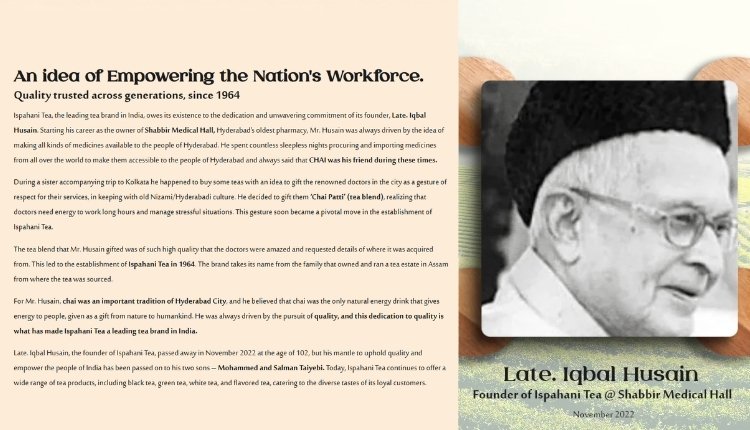
When Iqbal Hussain founded Ispahani Tea in 1964, the decision did not emerge from a conventional trading instinct. Hussain was a trained pharmacist, and his professional formation influenced the way he understood business. Precision, discipline and ethical responsibility were not optional values in his training – they were essential. He carried these same values into entrepreneurship.
For Hussain, products consumed daily were not trivial commodities. They formed part of people’s routines and influenced social interactions. Tea, in particular, represented more than refreshment. It was an energy source during long workdays, a pause in the middle of labour, and a social connector across communities. In cities like Hyderabad, tea functioned as a cultural equaliser – served in homes, offices, roadside stalls and markets alike.
A defining moment clarified the path ahead. During a visit to Kolkata, Hussain presented carefully curated premium tea blends to a group of doctors as a mark of respect. The appreciation he received was not casual. The doctors observed the blend’s distinctive balance of strength, aroma and uniformity. Their feedback revealed that consistent, high-quality tea – without fluctuation in taste – was not widely available.
Recognising this gap, Hussain established Ispahani Tea in Hyderabad. The city’s established chai culture made it a natural setting. From its inception, the company was structured around discipline rather than expansion targets. Quality control mechanisms were prioritised. Supplier relationships were stabilised. Blending methods were standardised to ensure that customers would experience the same taste profile repeatedly.
Aggressive marketing was deliberately avoided. Hussain believed that credibility built slowly through consistency would create a stronger foundation than promotional intensity. His objective was continuity, not short-term visibility.

Steady consolidation within local markets
The initial decades of Ispahani Tea were marked by quiet consolidation. Instead of pursuing rapid geographic expansion, the brand concentrated on strengthening its footprint within Hyderabad and nearby markets.
Distribution networks were carefully developed across residential neighbourhoods, the Old City and emerging commercial areas. The brand gained steady acceptance in households and tea stalls, where familiarity often determined purchase decisions. Small retailers and kirana outlets became crucial partners in reinforcing brand recall.
By the late 1980s and early 1990s, Ispahani Tea had established a structured and reliable distribution system across the city. It was no longer a new entrant but a dependable daily-use product. Working families and small business operators gravitated towards the brand because it delivered predictability in taste and pricing.
This phase defined Ispahani Tea as an everyday beverage rather than a luxury or experimental offering. Its strength lay in habit formation and repeat demand.
Leadership transition and organisational modernisation
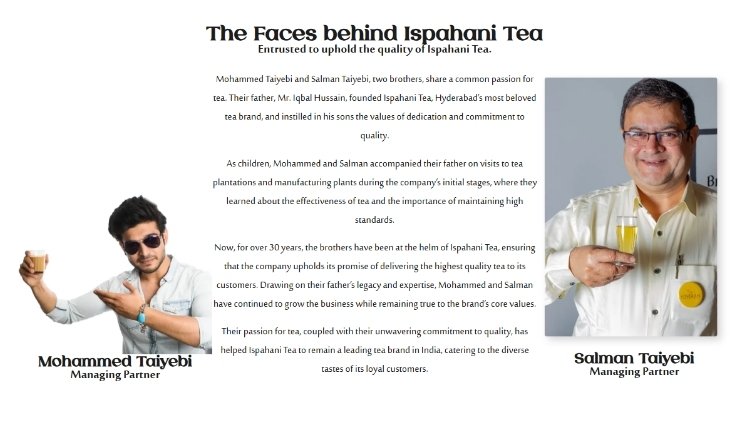
A significant chapter opened when leadership passed to Mohammed Taiyebi and Salman Taiyebi, the founder’s sons. The transition did not alter the company’s philosophy. Instead, it introduced calibrated modernisation.
Mohammed Taiyebi concentrated on internal systems and operational efficiency. As volumes increased, he ensured that quality benchmarks remained intact. Procurement systems were tightened. Supplier relationships were strengthened. Packaging formats were updated to meet contemporary retail standards. His emphasis was on scaling responsibly – increasing output without compromising flavour or blending uniformity.
Salman Taiyebi directed his attention towards brand presentation and market expansion. Recognising evolving consumer behaviour, he sought to position Ispahani Tea in formats that extended beyond packaged retail. Retail visibility improved, and the brand began exploring experience-driven spaces.
This dual leadership model allowed Ispahani Tea to grow structurally while remaining rooted in its founding ethos. Operational discipline and consumer engagement advanced in parallel.
Product architecture and strategic diversification
Today, Ispahani Tea operates through a layered product structure. Its foundational portfolio consists of strong black tea blends sourced from Assam, Darjeeling and the Nilgiris. These blends are designed for daily use and high repeat consumption, forming the backbone of the brand’s revenue stream.
Green and white tea variants address a segment of consumers seeking lighter flavours and health-oriented alternatives. These offerings reflect evolving consumption patterns without departing from the brand’s commitment to quality.
The launch of Finjaan in 2002 marked a significant diversification. Positioned as a premium and wellness-focused sub-brand, Finjaan introduced herbal and speciality blends suited for curated experiences and gifting. Importantly, this expansion enabled Ispahani Tea to participate in higher-value segments without altering its core mass-market positioning.
Another notable extension is Bhai ki Chai, a café-style concept that reinterprets tea as a social gathering experience. While the flavours remain familiar, the presentation aligns with contemporary urban expectations. This initiative broadens the brand’s appeal among younger consumers and urban audiences.
Establishing experiential retail presence
In 2022, Ispahani Tea achieved a symbolic and strategic milestone with the inauguration of its first flagship outlet at Mir Alam Mandi in Hyderabad’s Old City. The location was not incidental. The Old City has long been central to Hyderabad’s tea culture. By situating the flagship store there, the brand reaffirmed its connection to traditional markets.
The outlet integrates multiple brand components. It showcases classic tea blends, highlights Finjaan’s speciality offerings and incorporates experiential elements associated with Bhai ki Chai. More than a retail point, the flagship serves as a tangible representation of the brand’s evolution.
This step marked a shift towards direct consumer engagement through owned retail environments, complementing established distribution channels.
Chronology of major milestones
• 1964: Ispahani Tea founded in Hyderabad by Iqbal Hussain
• 1967: Introduction of early flavoured tea variants
• 1990: Expansion of structured distribution across Hyderabad
• 2002: Launch of Finjaan herbal and speciality tea range
• 2022: Opening of flagship store at Mir Alam Mandi
Position within Hyderabad’s tea ecosystem
In Hyderabad’s beverage landscape, Ispahani Tea occupies a stable and distinctive space. It is neither driven by short-term trends nor confined to exclusive premium positioning. Instead, it represents a dependable, volume-based brand integrated into daily routines.
Hyderabad’s tea culture reflects extended work schedules, dense neighbourhood interactions and commercial vibrancy. Ispahani Tea’s familiarity and accessibility align closely with these characteristics. Brand loyalty in such environments is often shaped by repeated experience rather than advertising campaigns.
Over decades, Ispahani Tea has evolved organically alongside the city’s expansion, retaining relevance across demographic segments.
Franchise model and structured expansion
The brand’s contemporary growth strategy emphasises franchising as a methodical expansion pathway. Its six-decade operating history, diversified retail formats and strong consumer recall provide stability for prospective franchise partners.
Key strengths include long-standing brand trust, centralised sourcing, standardised blending processes, multiple format options ranging from packaged tea retail to café-style concepts, and compatibility with high-frequency consumption patterns.
The franchise framework is designed around predictable demand, operational clarity and repeat customers rather than speculative premium positioning. This structure reduces volatility while enabling scalable growth.
Continuity anchored in discipline
From the founding discipline of Iqbal Hussain to the structured stewardship of Mohammed Taiyebi and Salman Taiyebi, Ispahani Tea’s journey reflects continuity reinforced by adaptation. The enterprise has balanced heritage with evolving formats, preserving its identity while responding to market shifts.
As it expands through franchising and experiential retail, Ispahani Tea continues to embody a Hyderabad-born brand that integrates generational leadership with sustainable enterprise design – a legacy built not on acceleration alone, but on endurance.
