

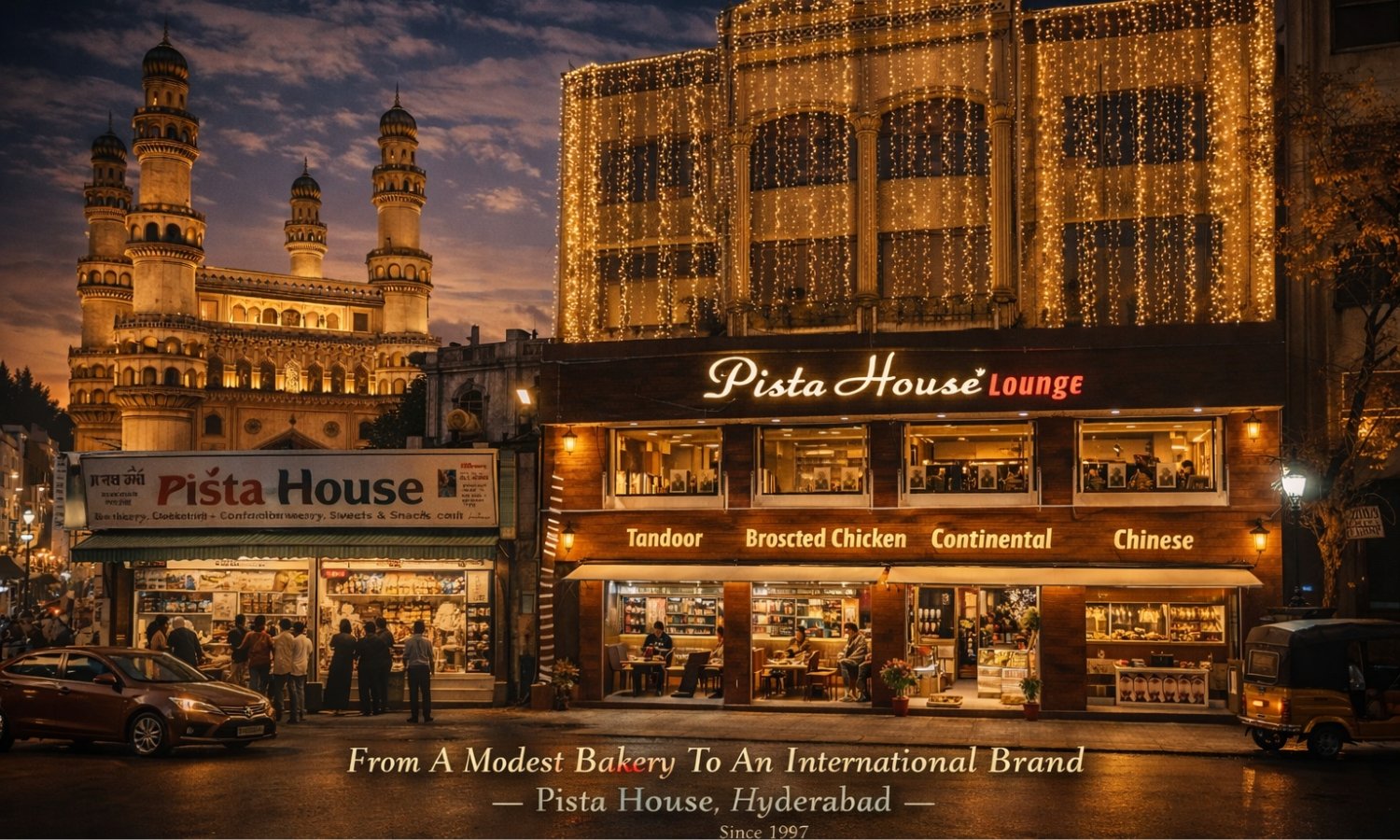
Hyderabad: The Pista House journey traced Hyderabad’s own transformation, as the brand grew from a modest Charminar-area bakery opened in 1997 into an international food name that stayed tied to Old City flavours and identity.
Founded by Mohammed Abdul Majeed, the business began near Charminar at a time when the city was shifting quietly. Traditional markets continued to draw crowds. Meanwhile, newer commercial centres started taking shape across Hyderabad. In that setting, the bakery focused on sweets and baked goods for daily customers, not elite dining circles.
Majeed came from a family engaged in the textile trade. However, he recognised that Hyderabad’s expanding population and changing tastes created space for a food venture. Therefore, he adapted early and built a small outlet that relied on familiarity, affordability and steady quality.
In the initial years, the bakery worked like many Old City neighbourhood shops. It served local residents who preferred consistent taste. Yet the operation gained attention for careful processes. Recipes were refined step by step. Ingredients were sourced with care. As a result, trust grew in an area where reputation travelled quickly through word of mouth.
The brand’s approach also stayed conservative by design. It offered food that felt known rather than experimental. That decision helped it retain customers who valued tradition, especially in a locality shaped by long-standing habits and community ties.
Pista House journey expanded beyond the Old City
As Hyderabad widened beyond its historic core, the business expanded with it. The shift from a neighbourhood bakery to a recognised food outlet did not happen overnight. Instead, growth followed local rhythms, including festival rushes, family gatherings and seasonal demand.
Over time, the name became linked to Hyderabadi cuisine and not only bakery items. Dishes with strong cultural associations strengthened the brand’s identity in the city’s food landscape. Consequently, outlets began appearing outside the Old City, serving customers in newer neighbourhoods while keeping the same flavour cues.
The early 2000s brought a consolidation phase. Hyderabad attracted fresh residents, including IT professionals and students. Many looked for authentic local food experiences in a changing city. In response, the brand widened its offerings and opened more locations across Hyderabad.

Even then, expansion did not dilute the brand’s character. Its menu design, visual language and service style continued to reflect the original identity. Moreover, the narrative link to Charminar and Shali Banda remained central, even when outlets operated far from the old lanes.
That continuity supported the brand’s positioning as a custodian of a food heritage, not merely a restaurant chain. Customers associated it with Hyderabadi flavours that felt anchored in tradition, even as the city’s skyline and neighbourhood map changed around it.
Pista House journey moved into international markets
Once it had built a strong local identity, the Pista House journey extended beyond India. The shift towards overseas markets followed demand from expatriate communities. Many Hyderabadis abroad sought flavours that reminded them of home. Therefore, the brand explored international opportunities linked to that audience.
For customers in unfamiliar cities, the outlets provided a familiar name and familiar tastes. In that sense, the brand served as a cultural bridge through food, built on the same Hyderabadi flavour memory that shaped its local rise.
The brand’s story later drew attention as an example of local enterprise growth that stayed connected to its roots. From a small bakery near one of Hyderabad’s most iconic landmarks, it moved towards a multi-country presence without discarding its origin narrative.
In the city’s evolving culinary landscape, the account of Pista House journey remained tied to patience and consistency. It reflected how a business could scale with Hyderabad’s expansion, yet still draw strength from the narrow lanes and everyday customers who shaped its early reputation.
