
₹6,000 crore allocated for Urdu and Indian language textbooks, says BBS

Hyderabad: The Union government allocated ₹6,000 crore in the coming financial year for the preparation of higher education textbooks in Urdu and other Indian languages, with a target of producing 2.5 lakh academic books, officials said on Monday.
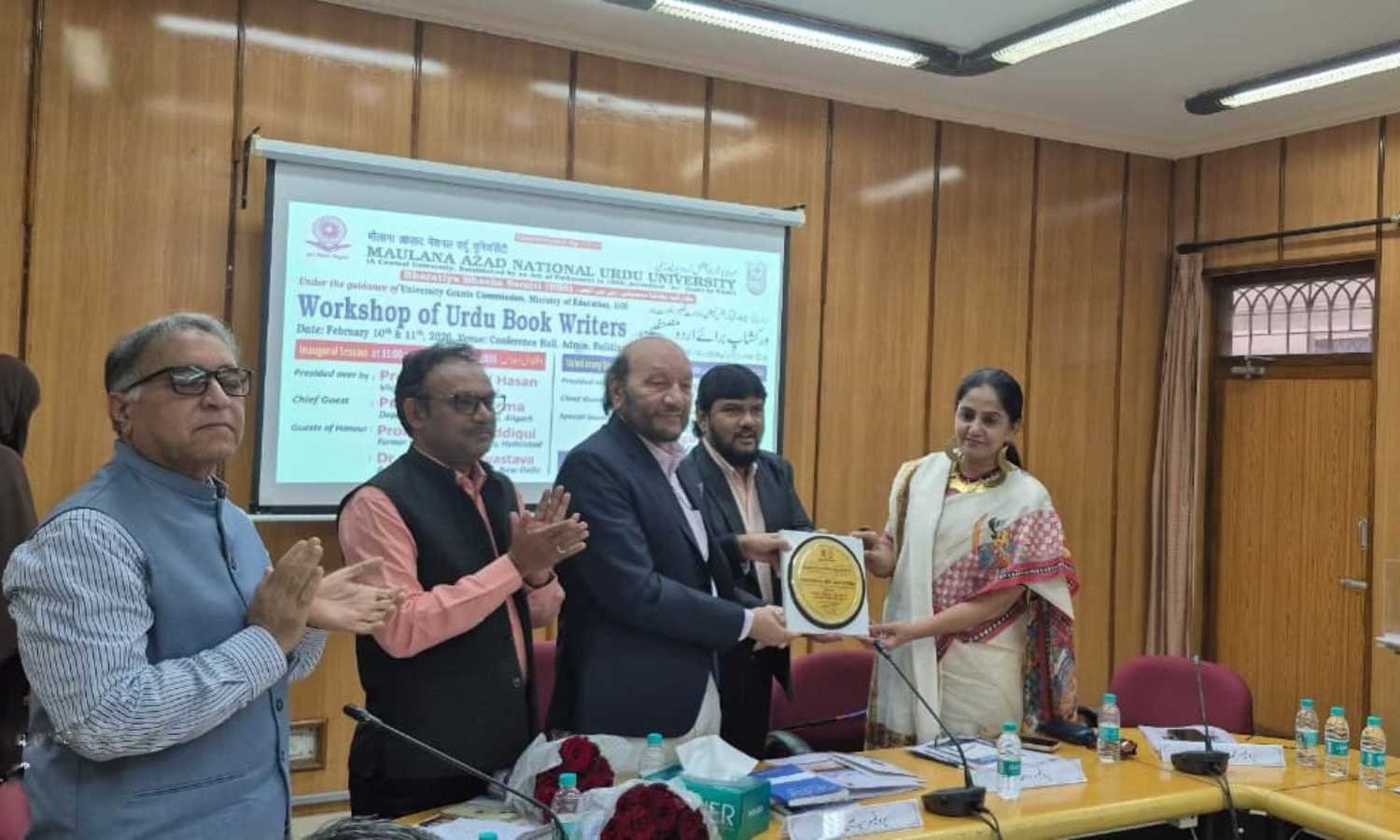
The announcement was made by Chandan Srivastava, Academic Coordinator of the Bharatiya Bhasha Samiti, New Delhi. He was addressing the inaugural session of a two-day workshop for Urdu authors at the Maulana Azad National Urdu University through an online address.
Vice-Chancellor Syed Ainul Hasan presided over the programme. Vibha Sharma, Professor of English at Aligarh Muslim University, participated as a special guest. Registrar Ishtiaq Ahmed and Razaullah Khan, Director of the Centre for Distance and Online Education, were guests of honour.
During the session, five books published by the Directorate of Translation, Translation Studies, Lexicography and Publication were formally released, including works on Indian knowledge systems, Kabir’s philosophy, early Arabic travelogues on India, and a compilation of speeches by the Vice-Chancellor.
Urdu textbook budget under NEP framework
Dr Chandan Srivastava said that under the National Education Policy, the Bharatiya Bhasha Samiti was entrusted with the preparation of university-level textbooks. He added that MANUU had been designated as the nodal agency for developing advanced Urdu textbooks across disciplines, with Professor Ainul Hasan serving as the nodal officer.
He said the project involved the services of nearly 4.5 lakh teachers and experts from over 1,000 institutions, with special emphasis on developing interactive e-books. He appreciated MANUU’s proactive role in Urdu textbook preparation, calling it a model for other Indian languages.
In his presidential address, Professor Ainul Hasan advised teachers to go beyond conventional syllabi and use the opportunity to enrich students academically. He said the NEP created a favourable academic environment for MANUU and stressed the importance of understanding Indian knowledge traditions.
Professor Vibha Sharma described Urdu as a democratic and inclusive language, stating that it was an integral part of India’s cultural soul. She said Urdu was not a religious language but a language of the nation.
The two-day workshop is being attended by university faculty members, research scholars, and external experts and authors, focusing on strengthening academic and instructional content in Urdu.
